HCL vs TCL vs ZCL Brake Wheel Pin Couplings focuses on structural and selection differences among the three brake-wheel available product families. The useful question is not whether a pin coupling looks suitable, but which measurable inputs allow one exact configuration to be reviewed with confidence. The ZCL Elastic Pin Gear Coupling with Brake Wheel is used as a technical reference because its published family spans ZCL1-ZCL9, nominal torque 250 to 31,500 N·m, and allowable speed 4,500 to 950 r/min across the published size range. Those figures describe a family range; the selected size must still satisfy all relevant limits on the same model row.
Frame the HCL vs TCL vs ZCL decision
A comparison is useful only when the same duty is applied to every candidate. For HCL vs TCL vs ZCL, compare the torque path, elastic interface, bore options, speed limit, envelope and maintenance access side by side. Do not treat different family names as grades on a single better-to-worse scale.
The measurable interface for this topic includes both shaft interfaces plus brake-wheel diameter, axial position, brake hardware clearance and guard envelope. Record those values before contacting suppliers when possible. If a value is not known, mark it as unknown and attach the shaft or machine drawing that can resolve it. An explicit unconfirmed detail is safer than an assumed dimension because a pin coupling family can offer multiple bore and shaft-hole combinations within one nominal frame size.
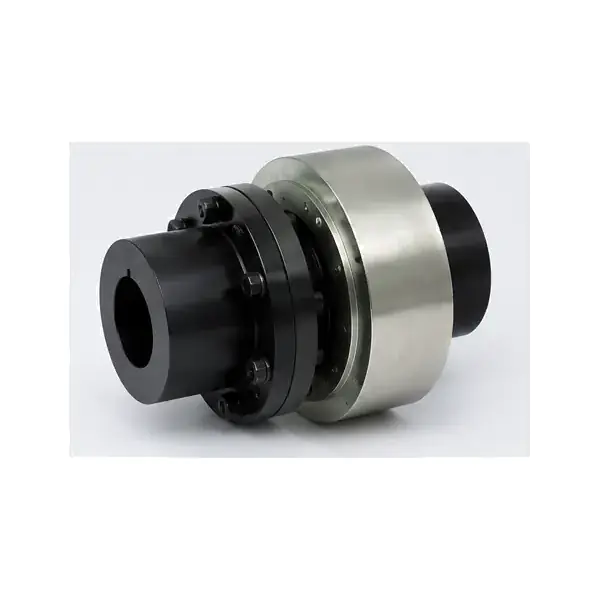
Use ZCL Elastic Pin Gear Coupling with Brake Wheel as a technical reference
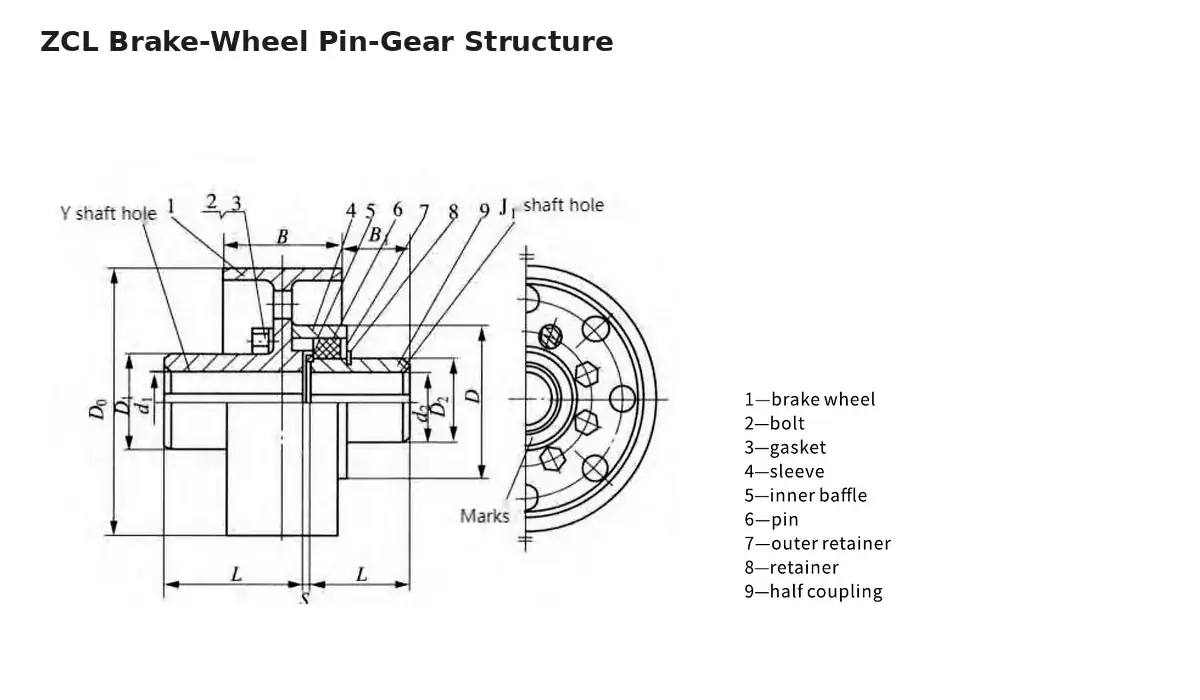
The ZCL structure combines a brake wheel with the pin gear coupling arrangement. The technical drawing identifies the brake wheel, bolt, gasket, sleeve, inner baffle, pin, outer retainer, retainer and half-coupling.
For this guide, ZCL Elastic Pin Gear Coupling with Brake Wheel provides a concrete reference point without implying that it is the automatic answer for every HCL vs TCL vs ZCL enquiry. Published data place the family at 250 to 31,500 N·m nominal torque and 4,500 to 950 r/min across the published size range allowable speed across ZCL1-ZCL9. The exact row also controls shaft-hole options and dimensional envelope. The published technical data notes that short-term overload should not exceed twice the nominal torque value; final design still requires model-specific bore and brake-wheel confirmation.
Translate the topic into machine data
The operating review for HCL vs TCL vs ZCL should capture frequent starts and stops, braking cycles, reversing where applicable, and heat or wear visible at the brake interface. These conditions explain how the numerical operating point is reached and whether the drive sees repeated transients, process contamination, restricted access or braking interaction. Record the speed at the coupling itself; do not assume the value from a motor or downstream shaft if a gearbox changes speed between them.
| Input | What to record for this review |
|---|---|
| Drive location | Exact shaft-to-shaft connection in Pin Couplings for Cranes and Hoisting Drives or the actual machine. |
| Torque basis | Normal transmitted duty or the driver/driven data needed to establish it. |
| Speed | Operating r/min at the coupling, including any relevant operating range. |
| Shafts | Both shaft interfaces plus brake-wheel diameter, axial position, brake hardware clearance and guard envelope. |
| Duty pattern | Frequent starts and stops, braking cycles, reversing where applicable, and heat or wear visible at the brake interface. |
| Maintenance | Access available for inspection, part replacement and re-alignment checks. |
Compare like-for-like criteria
To compare HCL vs TCL vs ZCL, create one common duty sheet and apply it to each candidate. Structural arrangement, nominal torque range, allowable speed, shaft-hole choices, maintenance access and any brake-wheel or taper geometry should be reviewed with the same inputs. A family with a wider published range is not automatically better; the relevant question is which available size satisfies the actual connection with the fewest unresolved interfaces.
Structural and selection differences among the three brake-wheel available product families should therefore be described as a decision between configurations, not a contest of marketing adjectives. If both families can satisfy the duty, the machine layout, service access, shaft preparation and order-specific requirements may become the deciding factors. If only one family provides the required interface, the comparison ends there regardless of superficial similarity.

Use a difference register
| Comparison point | Record the difference |
|---|---|
| Torque path | Which parts carry torque and where the elastic interface sits. |
| Shaft connection | Cylindrical or conical bore, shaft-hole lengths, keys and reference faces. |
| Speed | Allowable speed for the actual proposed size. |
| Service access | Which wear or elastic parts can be inspected or replaced in the installed position. |
| Special geometry | Brake wheel, outer jacket or taper features that affect the surrounding machine. |
A difference register keeps a comparison useful even when the final choice changes. It also prevents a model name from being treated as a direct replacement rule. For replacement work, add the existing coupling drawing and actual machine dimensions to the register before accepting interchangeability.
Compare brake-wheel families by the coupling structure behind the wheel
This topic becomes concrete when it is viewed at the machine rather than as a product-family label. HCL, TCL and ZCL all include a brake wheel, but the coupling sections behind it are different. HCL follows the elastic pin family, TCL combines a brake wheel with the elastic sleeve pin structure, and ZCL uses the pin-gear style arrangement with its retainers and outer components. A buyer should therefore compare the coupling torque path, service elements and available published sizes in addition to wheel dimensions. Choosing only by wheel diameter can produce a match at the brake and a mismatch at the shafts or duty.
Keep the discussion centred on structural and selection differences among the three brake-wheel available product families. Product-family information helps narrow the search, while the actual shafts, speed, torque and layout determine whether a specific size can be proposed. This is especially important when replacement work has accumulated field modifications that are not visible in the original model name.
Focused checks for this decision
| Check | Why it matters |
|---|---|
| HCL review | Check the HC-derived elastic pin structure, wheel geometry and exact shaft-hole options together. |
| TCL review | Check the elastic sleeve pin arrangement, sleeve access, wheel position and published model row. |
| ZCL review | Check outer/inner retainers, sleeve/pin arrangement, wheel geometry and available bore combinations. |
| Machine review | Confirm brake hardware position, shaft spacing, guard envelope and removal access for whichever family is selected. |
These checks are deliberately narrower than a generic coupling inspection. They are the items most likely to change the decision for HCL vs TCL vs ZCL. Once they are closed, the remaining general checks—torque, speed, both shafts, envelope, installation and maintenance access—can be reviewed without losing sight of the topic-specific risk.
A mistake to avoid
Do not assume one brake-wheel series supersedes another solely because its maximum torque is higher. The structural family, available shaft holes and equipment interface can be the deciding constraints.
If the required information is unavailable, mark it as confirmation required in the enquiry and ask for the drawing, measurement or operating record that can resolve it. A transparent unconfirmed detail is preferable to an apparently complete selection built on an assumption.
What the RFQ package should contain
The comparison should end with a selected family, exact candidate size, wheel diameter and the drawing dimensions still open. That result is far more useful than a three-column brochure comparison without machine geometry.
Keep the RFQ package concise enough that engineering, purchasing and maintenance can all identify the same proposed configuration. Include the coupling designation only after the duty and interface information are aligned; this prevents the product name from becoming a substitute for the machine requirements.
Installation and verification consequences
Whatever conclusion is reached for HCL vs TCL vs ZCL, verify the installed connection against the approved configuration. Confirm hub positions, shaft engagement, fasteners, pins, sleeves or elastic elements, retainers and any brake-wheel components. Check that the rotating envelope clears the guard and that the connected machines are aligned to the applicable machine/project requirements. After initial operation, compare visible condition, noise and vibration with the commissioning baseline.
What to confirm before requesting a quote
For HCL vs TCL vs ZCL, a useful quotation should name the proposed series and size, state the shaft-hole arrangement used for the proposal and identify any dimensions still requiring confirmation. Start with the ZCL Elastic Pin Gear Coupling with Brake Wheel page, use the selection workflow for the technical inputs, and review the application selection page for the related duty questions. Keep the three resources in that order: product facts, selection logic, then application context.
Frequently asked questions
What is the first data point to confirm for HCL vs TCL vs ZCL?
Start with the actual drive location and the machine input that controls the topic. For this guide that means coordinate coupling rating with brake-wheel diameter, shaft position and the actual start/stop duty.
Can a family range be used as a final model approval?
No. The family range is a screening tool. Torque, speed, shaft-hole options and dimensions must be checked on the exact proposed size.
Is a product photo enough for replacement selection?
No. A photo helps identify structure, but the replacement still needs both shaft interfaces, the machine envelope and the existing drawing or controlled measurements.
How should missing information be handled?
Mark the item as open and send the drawing or machine data that can resolve it. Do not fill an RFQ with assumed dimensions or unsupported performance values.
What should be confirmed before ordering?
Confirm the proposed series/size, both shaft interfaces, any brake-wheel or taper geometry, drawing revision, quantity and order-specific material or inspection requirements.
Prepare the RFQ
Use the global RFQ form in the footer for HCL vs TCL vs ZCL. Send the duty data and drawing together so the proposed model can be checked against one coherent set of machine inputs rather than a collection of assumptions.
Practical Guidance
Selection, installation and service checks
Use these checks when narrowing a series, confirming a replacement or preparing a quotation. They are intended to keep the chosen configuration tied to the actual machine duty and shaft interface.
Match one model size
For final selection, the practical approach is to coordinate coupling rating with brake-wheel diameter, shaft position and the actual start/stop duty. Use the family range as a first screen, then confirm the exact size before ordering. The selected size should use torque, allowable speed and shaft options from the same model row. If an input is unknown, state it as unknown in the enquiry instead of assuming a value. This keeps the selection traceable to the actual duty and shaft data.
Confirm the shaft interface
For the shaft interface, record both shaft interfaces plus brake-wheel diameter, axial position, brake hardware clearance and guard envelope. Measure from stable machine reference faces and distinguish the usable shaft engagement from nearby shoulders, spacers or guards. A replacement request also needs the existing coupling envelope and removal direction, not only a shaft diameter. For an existing machine, distinguish measured values from drawing values so any mismatch can be clarified before machining.
Review operating duty
Operating conditions can change the preferred configuration even when the steady running point appears simple. Review frequent starts and stops, braking cycles, reversing where applicable, and heat or wear visible at the brake interface. These observations belong next to the numerical duty because they explain whether the coupling is being asked to absorb routine transient behaviour or compensate for a machine problem that should be corrected elsewhere. A flexible pin coupling can accommodate limited relative movement by design, but it should not be used as a substitute for a sound base, correct shaft condition or proper alignment of the connected machines.
Inspection focus
Inspection should concentrate on brake-wheel reference surfaces, runout, hub fit, pins or sleeves, retainers and fastener security. Use the agreed drawing or configuration as the dimensional reference during inspection. If a project requires a specific material, treatment, inspection report or certificate, state it clearly in the enquiry so it can be confirmed for the order. Do not infer it from a similar model name or from a product photo.
After installation
Maintenance planning for HCL vs TCL vs ZCL Brake Wheel Pin Couplings should preserve safe access to the brake wheel, pins and elastic elements while preserving the alignment baseline. Establish a baseline after installation and compare later inspections with that condition. Changes such as loosened fasteners, displaced retainers, abnormal elastic-element wear, brake-surface issues where applicable, or new vibration should trigger a drive-train review rather than an automatic assumption that the coupling alone caused the symptom. Correcting the surrounding cause is as important as replacing a visibly worn part.
Before ordering
Before ordering, it is useful when the quotation and drawing use the same model designation, shaft configuration and open-item list. This helps compare quotations on the same duty and interface basis instead of using only a family name. Before ordering, confirm quantity, drawing approval needs, project-specific documentation, and any dimensions that still require confirmation. Commercial terms such as delivery schedule and packaging should be confirmed separately for the actual order.
Quick check summary
| Review item | Project-specific check |
|---|---|
| Selection basis | Coordinate coupling rating with brake-wheel diameter, shaft position and the actual start/stop duty. |
| Interface record | Both shaft interfaces plus brake-wheel diameter, axial position, brake hardware clearance and guard envelope. |
| Operating review | Frequent starts and stops, braking cycles, reversing where applicable, and heat or wear visible at the brake interface. |
| Inspection focus | Brake-wheel reference surfaces, runout, hub fit, pins or sleeves, retainers and fastener security. |
| Maintenance access | Safe access to the brake wheel, pins and elastic elements while preserving the alignment baseline. |